Picture this: a homeowner's water heater stops working on a Tuesday morning. They search for a local plumber, find your business with solid reviews, and tap "Call." Your phone rings. No answer. Voicemail kicks in.
Do they leave a message? Almost certainly not. Within seconds, they've backed out and tapped the next result on Google.
That scenario plays out thousands of times a day across small service businesses. And most owners have no idea it's happening, because you can't count the customers you never spoke to.
Voicemail Was Built for a Different World
Voicemail was revolutionary in the 1980s. It solved a real problem: what do you do when someone calls and you're not there? For decades, it was the best option available.
But customer expectations have shifted dramatically. The same generation now running households and making purchasing decisions grew up with instant messaging, same-day delivery, and real-time communication. Waiting 4–8 hours for a callback doesn't feel like a minor inconvenience — it feels like a signal that your business doesn't value their time.
80%
of callers hang up before the voicemail beep
67%
of millennials never check their own voicemail
5 min
is how long a customer will wait before moving to a competitor
90%
of business voicemails go unheard or unresponded to
The Psychology of the Unanswered Call
When someone calls your business and hits voicemail, they experience a small but significant moment of rejection. Not personal rejection — but a subtle signal that you're unavailable, disorganized, or simply not ready to take their business.
Compare that to calling a business and hearing a friendly voice (or AI) answer immediately: "Thanks for calling Riverside Plumbing, how can I help you today?" That experience communicates professionalism, readiness, and respect for the caller's time — before a single word of sales has been spoken.
"First impressions in business aren't just visual anymore. The phone call is often the very first touchpoint a customer has with you. Answering it — or not — tells them everything about your operation."
The Industry Breakdown: Who's Hurt Most?
Some industries are especially vulnerable to the voicemail problem. Here's why it hits service businesses so hard:
- HVAC & Plumbing: Calls are often urgent — broken furnace, water leak. Customers need help now and will call multiple businesses until someone picks up.
- Salons & Spas: Booking is time-sensitive. A caller wanting a Saturday slot will book elsewhere the moment they hit voicemail.
- Electrical Contractors: New customers finding you via Google are in decision mode. The first contractor who answers wins the estimate.
- Home Services (cleaning, landscaping): Recurring business is won or lost on first contact. A good first call means years of revenue.
Why Callbacks Aren't Enough
Many business owners say, "I always call back missed calls within the hour." And that's genuinely more than most do. But consider what happens in that hour:
- The customer calls 2–3 other businesses in that time
- One of those businesses answers immediately
- The job is booked — before you even know you missed the call
- When you call back, they've already moved on ("Oh, I already found someone, thanks")
In a market where 78% of customers go with whoever responds first, speed isn't just a nice-to-have — it's the deciding factor.
What Customers Actually Want
Extensive customer research on service businesses points to a consistent answer: people want to feel heard immediately. They don't necessarily need to talk to the owner or a senior technician right away — they just need confirmation that their request is received and someone is on it.
An AI that picks up, says hello, asks what they need, and either books them or logs the next step clearly satisfies this need perfectly. The customer hangs up feeling taken care of — not abandoned.
The Opportunity Hidden in Your Missed Calls
Here's a reframe worth sitting with: every missed call is actually a business problem with a known solution. You're not missing calls because you're bad at business — you're missing them because you're busy doing the work. That's a staffing and systems problem, not a talent problem.
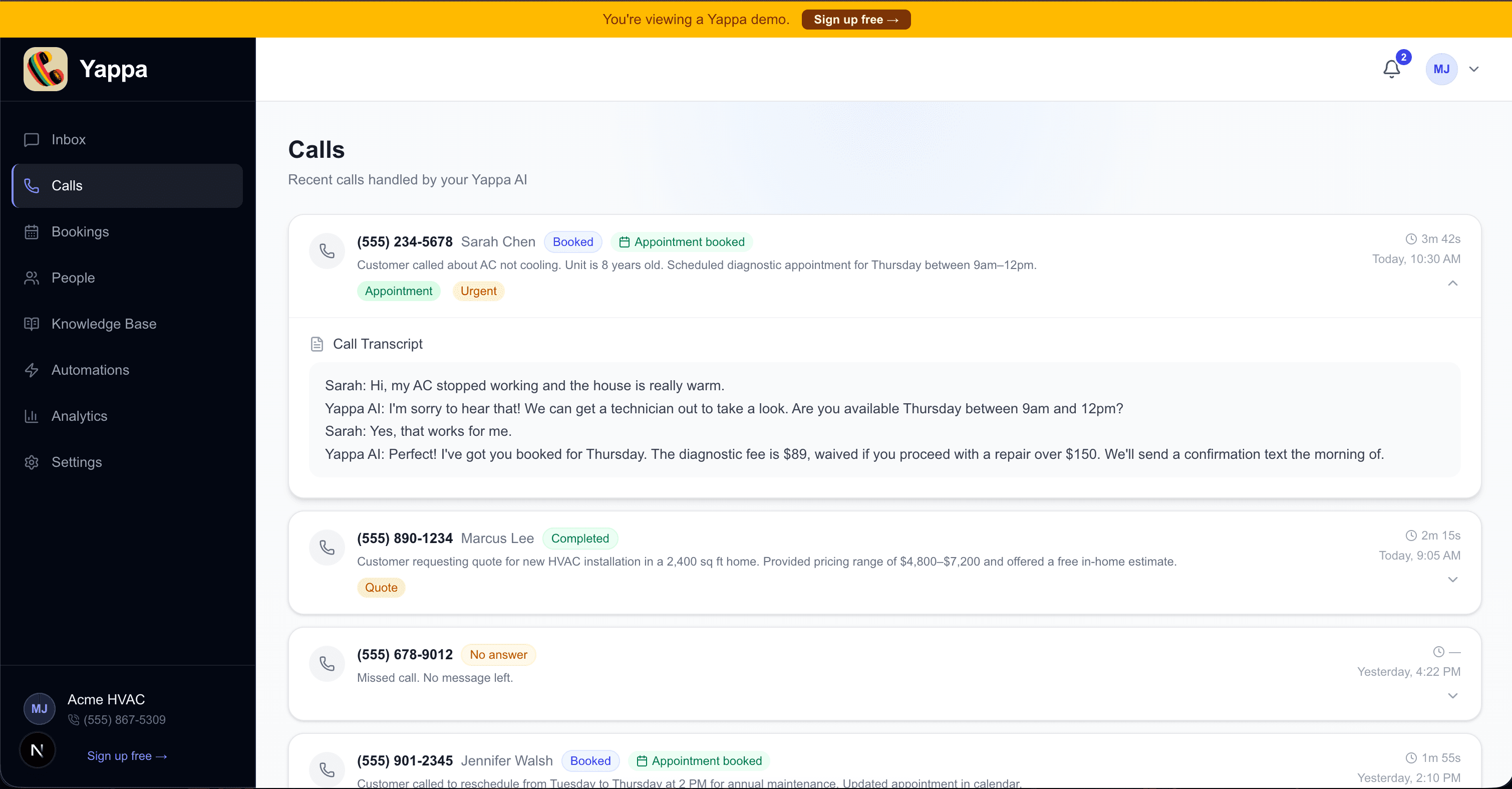
Yappa was built exactly for this moment. It answers calls instantly, 24 hours a day, 7 days a week — without you lifting a finger. It handles new inquiries, answers FAQs, books appointments directly into your calendar, and keeps every next step organized so nothing falls through the cracks.
What growth-minded service businesses do differently
The biggest operational difference between service businesses that feel calm and ones that feel chaotic is not usually demand. It is how they handle demand when it shows up all at once. Calls, jobs, quotes, and urgent questions all compete for attention, and without a repeatable intake system, the owner becomes the bottleneck.
That is why responsiveness compounds. The business that answers clearly, gathers the right details, and gives a caller a concrete next step will usually look more trustworthy than the business with slightly better reviews but slower follow-through.
- Define what information every new inquiry should provide before the call ends.
- Separate urgent calls, quote requests, and routine questions with consistent rules.
- Review common objections so your call handling keeps improving over time.
- Treat call coverage as part of revenue operations, not just admin work.
Why AI voice is becoming a real operating tool
Good AI voice is not a gimmick phone tree. It is a conversational layer that can greet callers, collect structured details, answer common questions, and move the call toward a useful outcome without sounding robotic. For busy operators, the value is speed and consistency more than novelty.
What changes in practice is simple: callers get a response immediately, your team gets cleaner intake, and the business gets a more searchable record of what customers are asking for. That combination is what makes voice AI useful even for small teams that do not think of themselves as especially technical.
How Yappa turns this into a repeatable system
Yappa is built for inbound service-business calls, which means it is not trying to be a generic consumer assistant. It is configured around your services, hours, FAQs, intake questions, and routing rules so the conversation sounds relevant to the business the caller thought they were reaching.
Instead of letting demand pile up in voicemail, Yappa can answer instantly, capture the caller details your team actually needs, flag urgent situations, and log transcripts and outcomes inside the dashboard. That gives owners a more consistent front door and gives staff better context before the human handoff happens.
- Answer every inbound call with business-specific context instead of a generic recording.
- Collect structured intake so callers are not repeating themselves to multiple people.
- Surface urgent conversations quickly when a real person needs to step in.
- Keep call transcripts, recordings, and outcomes in one place for review and improvement.
Never Miss Another Call.
Yappa answers every call in a natural, professional voice — day or night, weekends included. Your customers feel heard. You stay focused on the job.
Try Yappa FreeYou worked hard to get your business found online and to earn the reputation that makes customers want to call. Don't let voicemail undo all of that at the last second.